
Wormhole - A deep dive into Bridges

Connecting multiple systems together so they can inter-operate, is a dream in a Utopian world. Many today, are rather trying to achieve this overarching challenge in the real world where technology of today can eliminate the tremendous costs of transactions and transfers from one place to another. In the world of Web 3.0, this has been a consistent problem, the scalability. Blockchain is known to suffer from congestion and scalability issues.
Not unique to a particular chain, however, in some it gets too pronounced. Many brilliant minds across the world have come together to create one of the many unique protocols in this space that yields security, incentive to focus more decentralization, unification via aggregating many communities and shared ecosystem. Let’s have a look at this article, that aims to give an answer to the problem of scalability, data sharing, inter-operability and thus, efficiency through Blockchain!
Blockchain
As Don Tapscott safely puts it, “the Blockchain is an Internet of Value rather than being the Internet of Information”. While the technology is complex providing ground-breaking results and the word ‘Blockchain’ isn’t exactly resonant with the definition, the core concept however, is very simple. It enables a direct and authenticated connection between two parties, leaving no space for an intermediary or a third party. The economy today is in general, more aggregated (centralized) rather than being a sharing (decentralized) economy. Blockchain offers exactly that, making a more sharing economy and distributed decentralized system of working, thereby building more trust, reliability and efficiency since there are no intermediaries. The data embedded into uniquely identified blocks connected via chains, distributed to nodes in the network, is the fundamental working process. Having profound implications for many sectors in the world today, innovators in the field of decentralized finance (DeFi) are just beginning! The days of Franken-finance are gone as blockchain technology promises to give more potential and many opportunities for those who seize it.
There are yet many unrealised capabilities of this technology to be experienced in near future. To this end, there could be a few issues that needs immediate attention when looking forward to making it the ultimate breakthrough technology. We focus today, on the current most imperative problems in the ecosystem of Blockchain and its future development, that are:
The interoperability between different chains
The access to off-chain data.
Bridges
Crypto holders do not often use one blockchain system, there are multiple blockchain networks which expands into arbitrage of cryptocurrency from one chain to another. Bridges are designed for high transaction volumes enabling greater scalability. These eliminate the network effects that arise from different blockchains as well. Bridge is a piece of software that lets a user to transfer assets from one blockchain to another, solving the fundamental aspect yet again, interoperability. Bridges create a synthetic derivative that denote an asset from another blockchain. Think of it as a swap of a token from one chain to another!
Bridges work by having two smart contracts, one on each chain to provide blockchain infrastructure between two blockchains. For example, let’s say, you use bridge to send Solana coin to Solana wallet, that wallet would receive token that was wrapped by the bridge to a token based on the targeted blockchain. The Ethereum wallet would receive a bridged token version of Solana. These tokens are called wrapped tokens and these tokens can be used on blockchains which are non-native and cashed for the original cryptocurrency. This creates one of the biggest benefits – inter-operability between non-compatible blockchains.
Types of bridges
Custodial and non-custodial
Custodial are centralized bridges (central authority or trusted) whereas, noncustodial are decentralized (trustless/no-intermediary) which is used create bridging the assets. However, bridges that are either centralized or decentralized are safe at the current state.
Bridges, however, are often operated in a centralized way but bridges being decentralized is in theory!!
Bridges are mutually incompatible with each other. If made compatible, multiple bridges creates double wrapped tokens which leads to a complex process of wrapping the tokens to original token.
Are decentralized bridges really safe?
All decentralized bridges including Wormhole, as we will explore later, are exploited to hacks. Wormhole attack in recent times has been seen. That occurred because Wormhole allowed the attacker to mint 120k worth of wrapped Ethereum without having to stake any ETH. The attacker withdrew the free WETH (Wormhole Ethereum). According to CertiK, prior to the exploit, the bridge held a 1:1 ration of Ethereum wrapped on Solana blockchain throw escrow service. The exploit breaks 1:1 peg, although, Wormhole signifies that Ethereum will be added to the bridge over next hours, which remains unclear about the funds.
Trusted bridges have different risk challenges. Trusted or centralized bridges would face the staked assets to be corrupted, loss control over the assets or because of orders from third party like for example if a government orders the company to freeze assets which is part of regulations. The industry believes that bridges tend to have many weak spots. Bridge developers still haven’t perfected the code for linking two different blockchain. This is a key issue and the industry needs audits to be done every frequency to mitigate vulnerabilities.
The protocol built to serve yet another implication in the DeFi and the ecosystem, Wormhole has now surpassed many possibilities on the checklist of a Web3 enthusiast. It is simple message passing protocol across chains built on blockchain, creating not aggregated but unified and sharing economy. Digging deeper today, let’s figure out what Wormhole is all about, along with highlighting the quantum leaps and future prospects, the protocol has in store for us!
What is Wormhole?
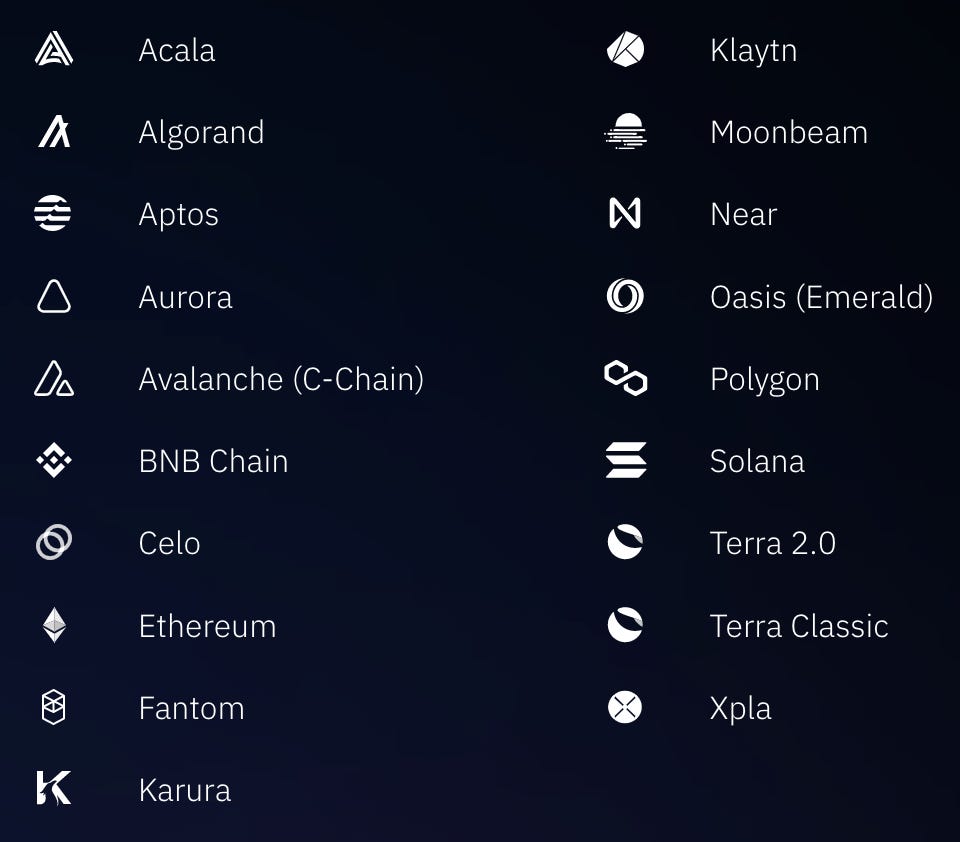
Launched in September, 2021, Wormhole is designed to serve the above-mentioned two major gaps in the ecosystem. When addressing these problems, Wormhole has made it possible for different chains to interact and connect, post-verification by the majority of Guardian network. There are numerous chains supported, to bridge both the token and NFTs coherently between different ecosystems and 7 different runtimes across EVM, Move VM, Solana, Cosmos etc and many upcoming. The protocol’s total volume stands at over $40B, with millions of transactions completed. Below is the list of 19 fully integrated chains, namely, ‘xChains’ on Wormhole.
This type of generic messaging entails not just asset transfers but also for applications like cross-chain voting or playing games, where one could own assets on one chain and make moves on another one. With this, Wormhole can also enable the possibility of exchanging ‘xData’ or cross-chain data, to improve services and efficiency.
Furthermore, the tokens and NFTs are nothing but ‘xAssets’, as cross-chain assets are named on Wormhole, that are transferred using ‘xDapps’, short for cross-chain decentralized applications. Two specific xDapps that help in the same regard are the Portal Token Bridge and Portal NFT Bridge. The portals are built on Wormhole protocol, acting as a bridge between chains. The important property that makes this bridge more unique in value other than just exercising inter-operability, is the non-existence of double or triple wrapping problem. Quite simply, as and when the wrapped assets are transferred between chains and within the Wormhole network, the asset will retain the same wrapper as it was in the source chain. Therefore, when moving between chains, the asset will not get wrapped again and again. Below is an image from the portal token bridge.
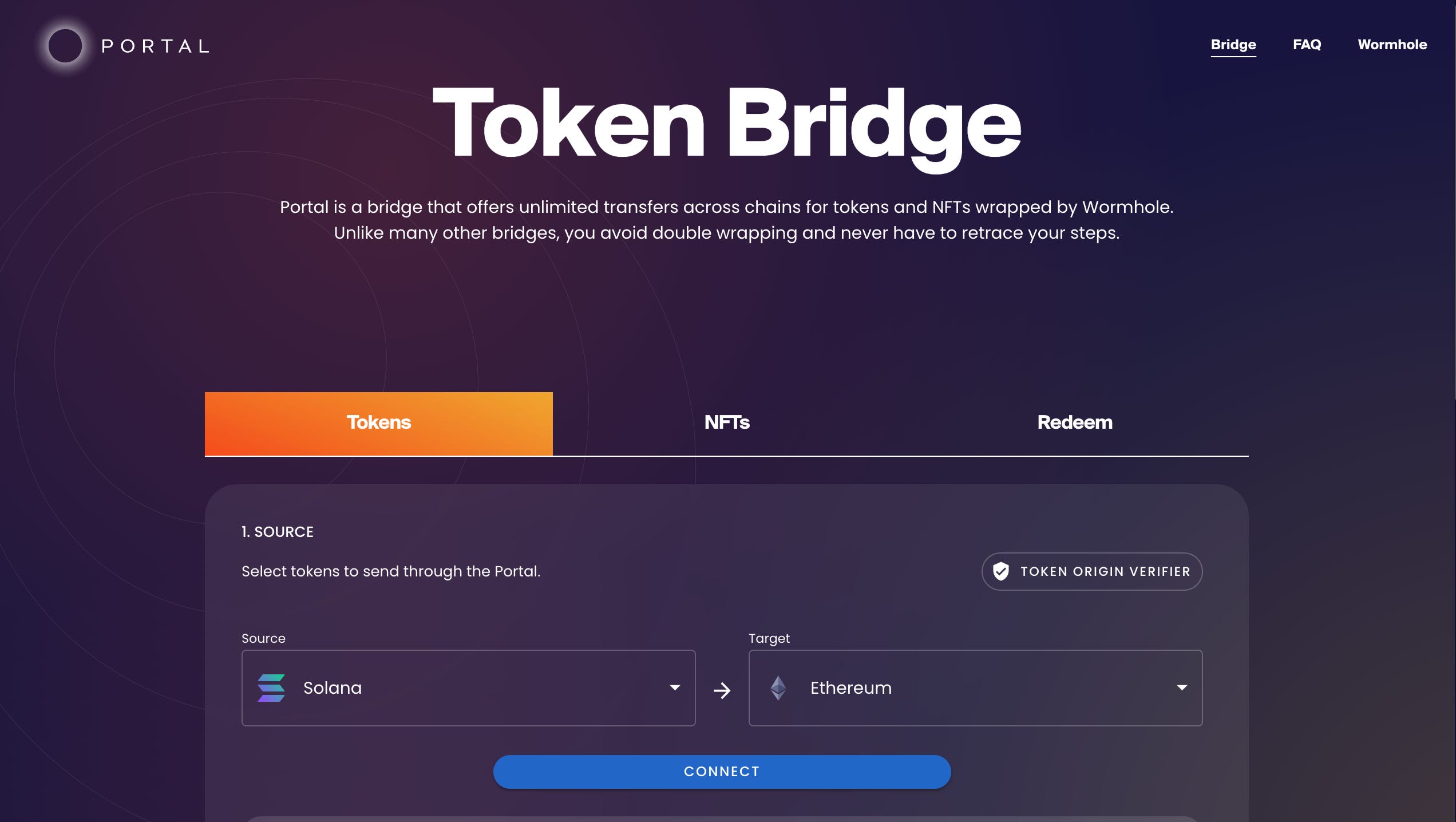
Post-connecting wallet for the source chain and selecting a target chain, we can seamlessly perform a transfer of tokens and NFTs, while also redeeming them if the tokens are seen to be not sent. The whole programming technically is of course an output of brilliant minds, the Eureka moment for Wormhole, however, is to have users experience a smooth transfer of an asset across different chains, increasing the use of inter-operability that also helps in accessing off-chain data. Following simply three steps and your transfer for tokens, NFTs or redeeming, is done. This process also contributes towards increasing liquidity at large.
How does the transfer work though?
Wormhole first deploys a Core Bridge contract for all of these chains. The contracts are nothing but smart contracts.
The cross-chain functionality, is not as complex. This is done via releasing messages from one chain (core contract), say, Ethereum.
These messages are binary data stored as a single entity that are emitted and then perceived by a network called ‘The Guardian Network’ of nodes, that verifies these messages thus creating a Verified Action Approval (VAA). These guardians are a collection of 19 nodes, available on several blockchains known to be the elite or professional nodes. They verify the messages, sign them without communicating with each other and collectively forming a multisig (a group of users signing a single document). These multisigs are ultimately the VAAs.
NOTE: Using Wormhole Explorer, one can see the signed VAA and related message data, payload data etc. after the message has been observed by the guardians. The list of guardians, we notice on the wormhole explorer will be also be found on solana making it prone to centralization risk.
A majority or preferably (2/3)+ nodes that verify the same, are further submitted to the target chain, say, Solana.
Too much Jargon!! Let’s examine carefully, how the process works in detail -
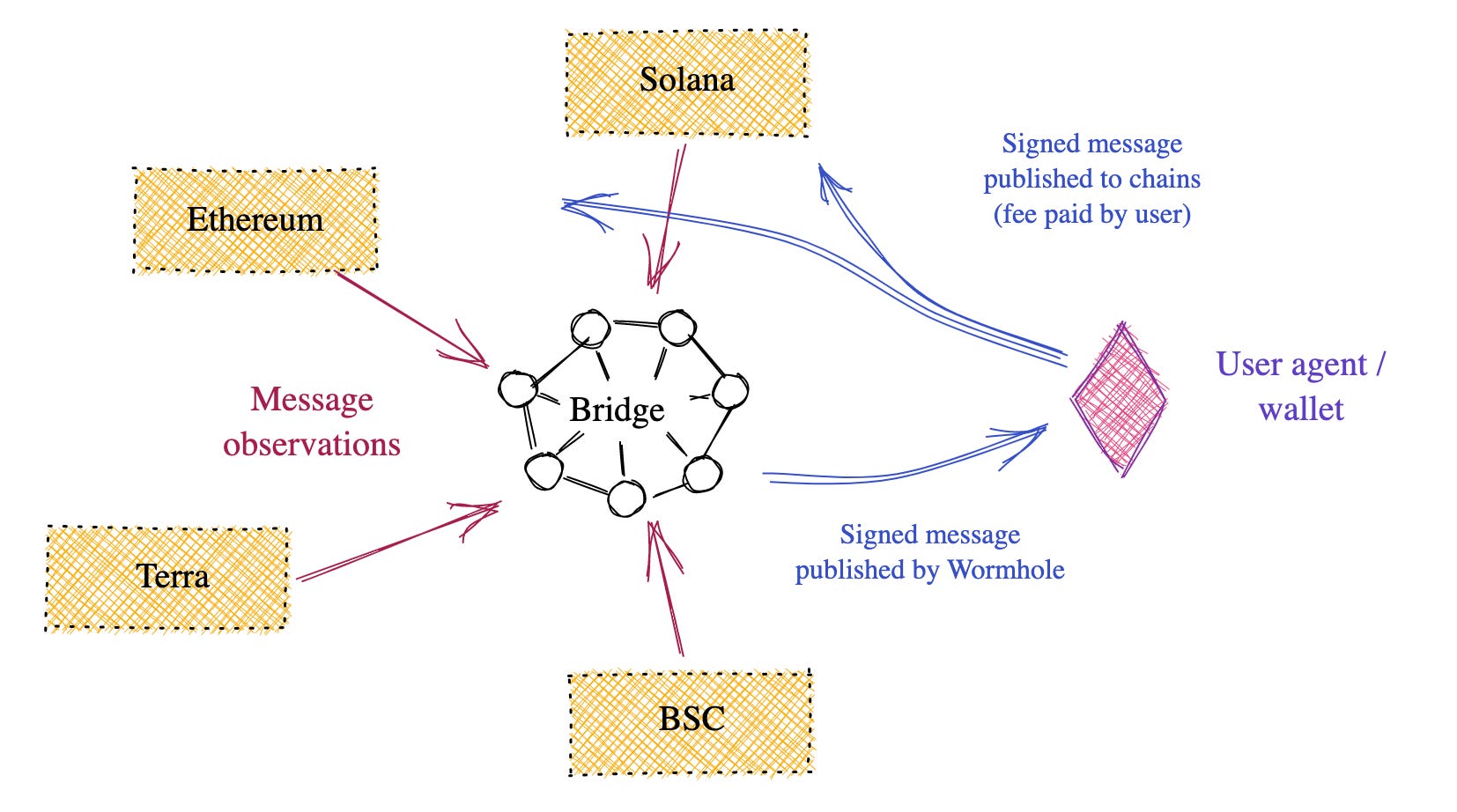
When making a transfer of tokens from say, Ethereum to Solana, the protocol allows us to first lock them on Ethereum and then the wrapped version is minted on Solana. The messages therefore, would have the data of what is happening. The first ‘Transfer’ message will indicate an emission containing important data required for the target chain. Post completing the lock up event, chain Solana would then move on to known the name, contact address, symbol and decimal precision of the asset (from the message received) for correctly minting the amount of tokens that are up for the transfer. The process is thus called ‘Attestation’. In the process, the tokens are picked and submitted through or across chains using ‘Relayers’. The core bridge address is derived after verifying VAA again (on Solana) and finally the user can claim the amount. This serves us perfectly!
Relayers
Now, the VAAs that verified messages approved by the guardians cannot themselves walk towards the target chain to be minted. Here comes the relayer, that simply picks these VAAs and submit to the target chain. The function being as similar to the player in a relay race. These relayers can be anyone, the individual users or automatic relayers. You can manually fetch your message from the guardian and make a submission. Normally, the xDapps built on Wormhole bridge are employed to work as a relayer, which are automatic ones. The automatic ones however, charge a fee to cover the cost for the gas when submitting a transaction or a transfer. This fee is usually subtracted as a portion of the token amount. It is imperative to know that within this untrusted environment, these relayers cannot in any case, counterfeit a VAA, since they do not perform a cryptographic function. Although, if they do play around with the code, it gets rejected at the target chain bridge contracts.
The portal NFT bridge is nearly identical in working as compared to the token bridge. It is important to note that unlike token bridge, an attestation is not needed for an NFT transfer. This is because all the relevant data is passed in the transfer of that single asset. Post completion of the transfer message, the NFT bridge will mint the asset or the token, aligning with the NFT standard of the target chain.
A win-win situation for all!
Wormhole is in action to build as many partnerships and projects to make their mission of fundamental interoperability, large scale. Contributing towards the common goal, these partnerships are deeply committed to bringing a much secure environment for the users worldwide, using these platforms. With many chains joining the Wormhole almost every two weeks, the protocol is taking a step towards a bigger and a better vision. Let’s see what has been cooking up in these cool hand-shakes taking places very recently!
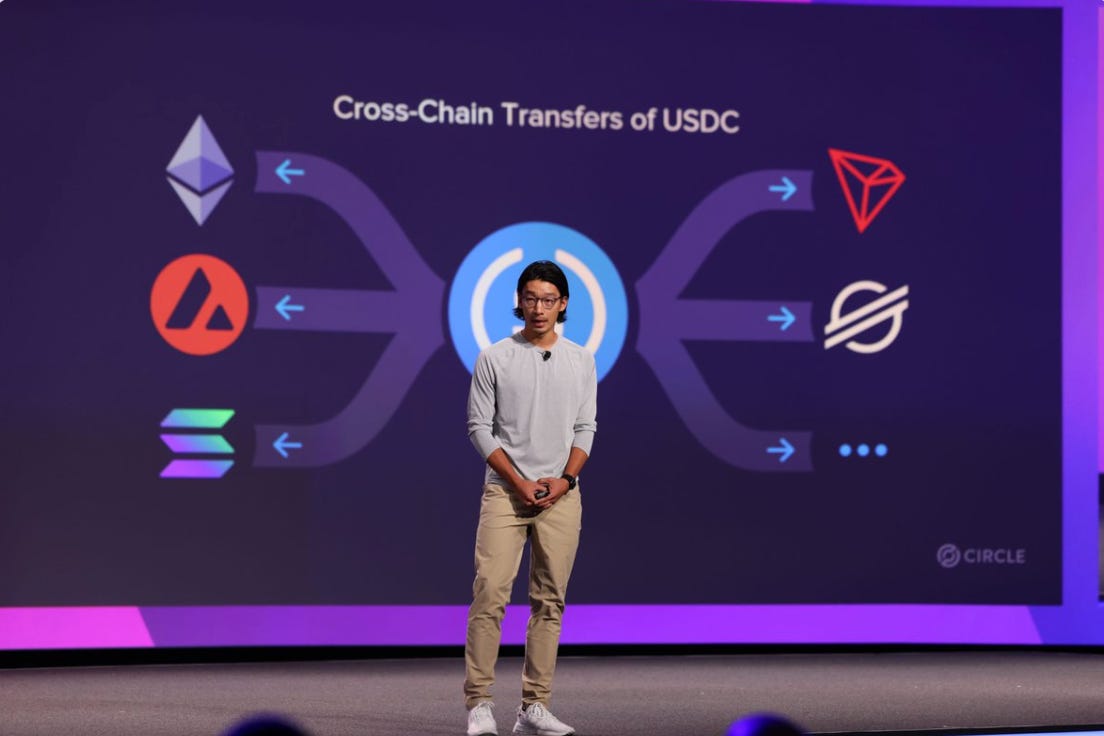
Most recently, the Circlepay has joined hands with Wormhole in supporting the interoperability of USDC across chains and taking a step towards unified liquidity as well. Similar to this, Moonwell community also chose Wormhole as a go-to xChain bridge.
Also recently, there has been an elating news of Sweat Economy that is designed to reward users with physical activity by leveraging the DeFi parameters such as NFTs. Starting of a Web 2.0 application, the Sweat economy had moved to Web 3.0 creating SWEAT tokens which are now a true xChain asset. Wormhole has now moved on to bridge SWEAT to Ethereum, living as a native ERC-20 token.
One of the many partnerships, such as Frikiton too has moved on to use Wormhole for enabling the transfer of APT tokens from Aptos to Solana, increasing the usability yet again for many users across the world.
The first decentralized Omnichain financial platform has recently made use of the Wormhole protocol for its omnichain swap function.
One of the notable projects forth-coming is the Human routing protocol. Here, the idea is to enable cross-chain $HMT from the source, Ethereum. The protocol can leverage the Wormhole SDK to do so. Not just limited to this, the proposal also aims for enabling users to vote from any chain that the Routing Protocol supports. The project focuses on to improving the common goal of multi-chain operability along with bringing an on-chain governance model for furthering the idea of decentralization and increased unified communities. Also, given the continuous dedication towards safety and viability while also being audited every month (14 times by multiple firms), another goal that is yearning to be achieved through this proposal is increased security mechanism.
Another remarkable partnerships was also recently noticed between Allbridge and Wormhole. Ufff…. Competitors Turned ‘frens’!!

The Allbridge is similar to the portal bridge with same function of tokens to be transferred across chains. The result of this new and striking partnership is the Allbridge Core, a single-click solution for bridging native stable coins between chains. There is no need to wrap and unwrap the transferred tokens. One cool feature the product offers, is paying the transaction or gas fees via converting part of funds into gas tokens. To perform the transactions completely wrap-less, Allbridge makes use of Wormhole’s core layer. As an outcome of this new friendship, there exists an ambience much higher security for the users currently on Allbridge.
Some Attention Points -
Other than boosting liquidity via easy xAssets transfers through Wormhole, there are countless use cases for cross-chain capabilities that come along. While researching, it was remarkable to see how the inter-operability can also feed the need for state sharing, governance models, swaps, bridging chains to unify many communities worldwide and also can be used for gaming. Here some of the cases that come along with the cross-chain capability but should be given some attention to -
Problems
Efficiency over liquidity - Bridges like Wormhole, often try to fill the gap of the fundamental problem arising nowadays, lack of interoperability. With this, comes huge liquidity when assets are transferred across blockchains. Developments in this area, is tremendous and noteworthy, however, the amount of liquidity within, must be sufficiently maintained as well. Consider a real-world bridge with cars on each end of it. One Ferrari goes towards the other end, another Bughati comes through. A Honda comes through as well, with another Volkswagen too. More and more cars filled with passengers will keep going through simultaneously, perhaps turning into a collapse. The main idea should be to rather increase the efficiency of capital management rather than increasing the liquidity, maybe through a rewarding system.
Token Diminishing Problem - This might also in future entail that huge token emissions made through a bridge can also make the token diminish in the prices, gradually.
Unsustainable? - The metrics of many asset-transfer bridge is very important. For a huge reputed bridge like Wormhole, it is rather imperative to understand what can be a good indicator of the longevity of this bridge. Excessive emissions might mean a Narnia world for many users but can become incessantly heck of a task to keep up with when financially running out of fuel. This can lead to a poor health of a protocol.
The Landscape -
Counting today, we have so many bridges to work with in the field of Web 3.0 for a cross-chain transfers. However, how Wormhole stands out is yet another most important aspect for our readers to know. Let’s dive into some of the well-known competitors that thrive against Wormhole at the top positions !!
Binance bridge -
It integrates CeFi and DeFi bridges. However, this bridge is known to be quite very vulnerable and with a few regulation issues thereby, impacting the security factor. According to the real time experiences of some users, the time taken to make a transfer is quite long making many shift towards different protocols or the same old traditional method.
Multichain -
A cross-chain router protocol which enables data and assets from to different blockchain networks. It supports highest number of blockchains for bridging along. Being a decentralized bridge again, it is quite vulnerable to hacks.
Avlanche Brige -
It is used to transfer ERC20 tokens from Ethereum to Avalanceh's C-chian. This chain is secured as the dapp itself is bridging with the network within Ethereum blockchain. Security - not much vulnerable and enhances low transaction costs
Closing Remarks -
Cross-chain is still an huge threat to the blockchain industry. Both the trusted and trustless bridges are vulnerable to attacks. This is because of the lack of audits that needs to be at a frequent levels. Wormhole audits were done at a frequency of 5 time every 6 months. However, the opportunity is to enhance the audit range to at high frequency rates. According to Ethereum's founder - he believes the future is multi-chain but not cross-chain as he says there are fundamental limitations to the security of bridges that integrate with multiple blockchain networks which in other languages multiple zones of sovereignty. Vitalik says that the problem arises when bridges go beyond multiple chains which will end up with many interdependencies between those chains. As the problem is we cannot just pick and choose a separate data layer and security layer as the data layer must be a security layer which how a signifies security and immutability.
My take would be, for cross-chains to sustain there needs a set of guidelines and high frequency security audit checks for the sustainability of the ecosystem and as the space been emerging right now, this opportunity around audits would play a key aspects in the growth of cross-chain bridges. The opportunity and immediate solution cross-chain bridges should focus on is to increase the auditing frequency.
Check out -
The space has become very approachable with these developments!